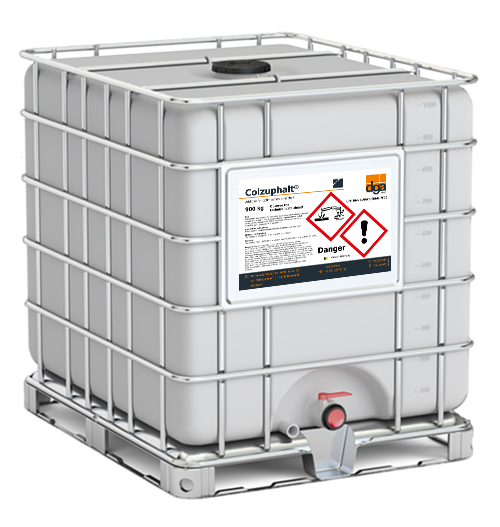
Surface-active, reactive additive for reducing the application temperature of asphalt mix (low temperature Asphalt)
Would you like a non-binding offer or do you need technical information? Contact us!



Surface-active, reactive additive for reducing the application temperature of asphalt mix (low temperature Asphalt)
Would you like a non-binding offer or do you need technical information? Contact us!
Colzuphalt® is an additive for optimising asphalt when the adhesion between mineral and binder as well as the processing properties of the asphalt mixture are to be improved. At the same time, Colzuphalt® serves to lower the laying temperature of asphalt mix.
Colzuphalt® is an additive for optimising asphalt when the adhesion between mineral and binder as well as the processing properties of the asphalt mixture are to be improved. At the same time, Colzuphalt® serves to lower the laying temperature of asphalt mix.
Colzuphalt® is a reactive additive with multiple effects. First, it acts as a wetting agent, i.e. the surfaces of the minerals, especially in the filler area, are coated with the additive in such a way that the surface tensions change to enable improved coating with the binder. Colzuphalt® then reacts during subsequent processing to form a highly effective bonding agent.
The adhesion between bitumen and mineral is permanently improved in the asphalt mixture. Both reaction phases simultaneously reduce the temperature and improve workability.
The workplace limits for bitumen emissions were significantly reduced for preventative protection of the employees. For road construction with rolled asphalt, an industry solution comprising several elements was developed: On the one hand, the emission of vapours and aerosols on the paving equipment was optimised through design innovations, and on other hand the rolled asphalt is manufactured and applied at a lower temperature.
By using our Colzuphalt® additive, rolled asphalt can be produced at up to 30 °C lower temperatures while still achieving optimum compaction performance during rolling.
Colzuphalt® is not a wax and has no crystallization point. In contrast to wax-modified asphalts, this means that the asphalt mix can be compacted below 110 °C. The structure of the mix is not negatively affected.
Colzuphalt® lowers the application temperature of rolled asphalt and mastic asphalt. In addition, it can be used to optimise bituminous chippings.
Colzuphalt® is added as an additive during the mixing process at the asphalt mixing plant. It is also possible to supply Colzuphalt® in a pre-mixed binder. When processing mastic asphalt, Colzuphalt® can also be added on-site in the agitator boiler.
Yes, Colzuphalt® is the only surface-active additive listed on the BASt list (as of 10/2024).
Colzuphalt® was intensively investigated as part of the BASt research project “Absenkung der Produktions- und Verarbeitungstemperatur von Asphalt durch Zugabe von Bitumenverflüssigern” (“Lowering the production and processing temperature of asphalt by adding bitumen liquefiers”, FE 07.203/2002/CRB from 2006), and the test track was scientifically analysed over a period of years. All results are available on the BASt website.
Due to its excellent performance, Colzuphalt® has made it onto the BASt list “Erfahrungssammlung über die Verwendung von Fertigprodukten und Zusätzen zur Temperaturabsenkung von Asphalt” (“Experience gained from the use of finished products and additives for lowering the temperature of asphalt”).
Lowering the mixing temperature by 30 to 35 °C, as is possible with Colzuphalt®, for example, it is possible to reduce the energy consumption by 0.8 litres of heating oil per ton of asphalt. With 60 million tons of asphalt produced in Germany each year, this results in a potential energy savings of almost 50 million litres of heating oil.
This also offers enormous potential for reducing CO2 emissions: For a total of 60 million tons of asphalt, which leads to the emission of approximately 1.5 million of CO2, laying asphalt at lower temperatures would lead to a reduction of 125,000 tons of CO2.
Yes, Colzuphalt® increases the adhesion between the mineral compound and binder.
This effect is particularly important for the service life of asphalts when using low-adhesion mineral compounds. Independent studies confirm the positive influence on adhesive behaviour, e.g. research report FE 07.203.2002/CRB of the BASt*.
The binder characteristics are not changed significantly. Colzuphalt® improves the properties of the asphalt mix. The effect of the additive arises through the interaction between the binder and the mineral compound.
For the client, this type of modification therefore does not represent a disadvantage in terms of existing regulations.
All additives used to reduce the temperature of asphalt lose their effectiveness in hot bitumen as the storage time increases. Since surface-active additives such as Colzuphalt® do not alter the rheological properties of the additive-enhanced binder, the effectiveness of the additive on the binder cannot be verified using conventional methods. Due to this problem, the dga group has developed its own method to prove its effectiveness. The results of this procedure correlate well with practical experience, so that based on current estimates, an expected storage life of one week at a storage temperature of 160 °C can be assumed.
LT binders are meant to be processed quickly and only stored for longer than one week in exceptional cases. In these cases, an initial increase in the additive can extend the effectiveness of the LT binder over time. Lowering the storage temperature to 130 °C protects the LT additives and also extends their effectiveness in the binder.
Odour emissions are produced during the production and application of asphalt that are mainly due to the added bitumen. These odours are caused by the release of volatile organic compounds (VOCs) and other odorous substances, especially when the material is heated to temperatures between 140 °C and 230 °C. The perceived intensity of the odour increases as the asphalt temperature rises. This is particularly evident in the case of mastic asphalt, which is processed at significantly higher temperatures of 210 °C to 230 °C and is therefore perceived as much more odorous.
Colzuphalt® is used as an additive to reduce the application temperature of the asphalt by up to 30 °C. This reduction in temperature noticeably reduces the formation of odours when paving. The inherent odour of Colzuphalt® itself is described as mild and characteristic at the usual processing temperatures for asphalt. Overall, Colzuphalt® is considered to be low-odour when used in asphalt and does not produce any unpleasant odours.
Colzuphalt® consists of various organic components. Like all organic compounds such as bitumen, waxes, or cellulose fibres, Colzuphalt® decomposes when burned. This can release gases such as carbon and sulphur oxides. However, at normal storage and processing temperatures (5 – 180 °C), no hydrogen sulphide or mercaptan vapours are produced. These substances are only produced at temperatures above 300 °C.